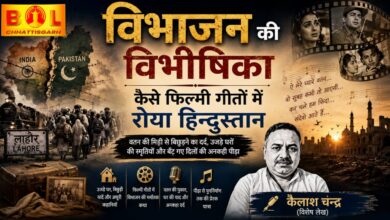
The Tragedy of Partition: How Film Songs Made India Weep
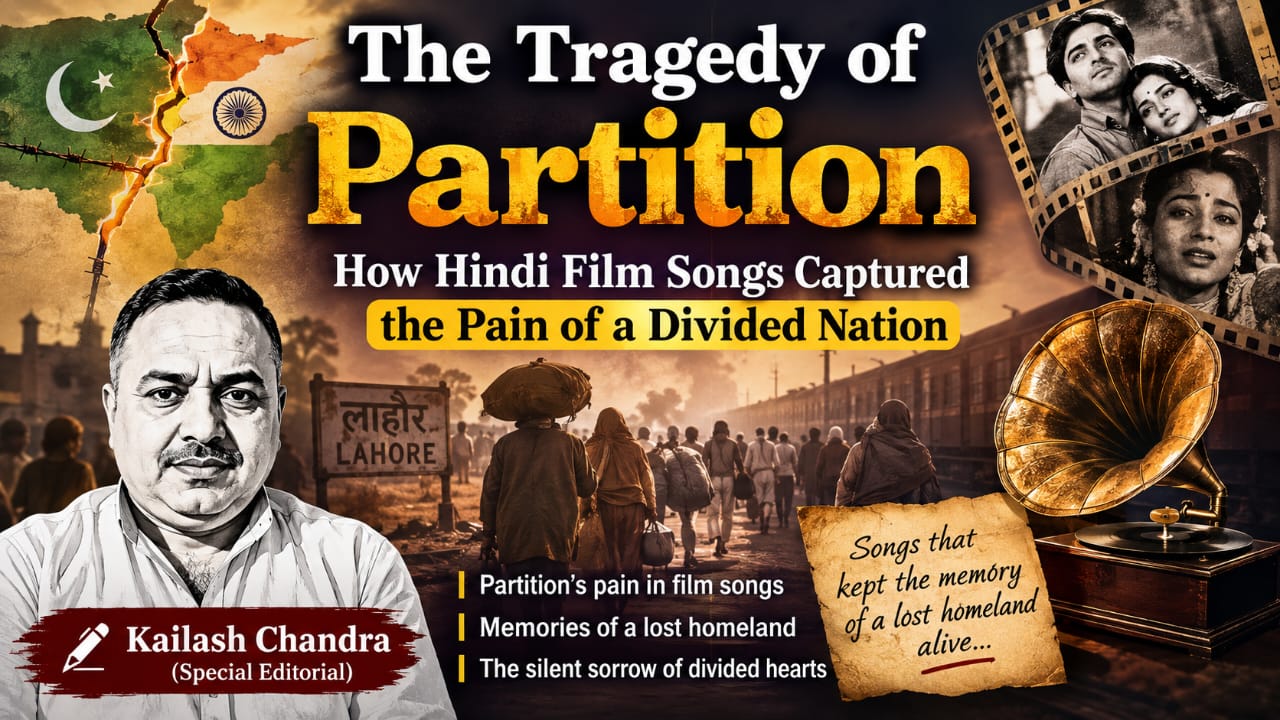
The Partition of India was not merely a division of geography. In 1947, a political boundary was drawn across the subcontinent, but that line also cut through the lives, families, memories and relationships of millions of people. Even today, many families continue to carry the pain of that separation.
Homes were abandoned. Villages were left behind. Fields, neighbourhoods and ancestral properties were lost. Families were separated and, above all, people were forced to leave behind the soil they had always called their own.
The tragedy of Partition can certainly be studied through the language of history—with dates, statistics, political decisions and descriptions of violence. But to understand its human cost, one must also turn to literature, poetry, cinema and music.
Hindi cinema has portrayed Partition in different ways. Film songs, in particular, gave an emotional voice to pain that ordinary historical accounts often fail to capture. Even today, some of these songs can make us feel the loneliness of displacement, the longing for home and the sorrow of separation. The political boundary between India and Pakistan became permanent. But there was no boundary for memory. And so one question kept returning through the emotions expressed in songs: How can a home that was ours for generations suddenly become a place we are no longer allowed to call our own?
When ‘Watan’ Became a Memory
Before Independence, the word watan primarily meant one’s homeland—the land of one’s birth and the country one wished to see free.
After Partition, however, the meaning of watan acquired a deeply personal dimension. For many people, watan was no longer simply India or Pakistan. It was the town where they had grown up. It was Lahore, Amritsar, Rawalpindi, Multan, Peshawar, Dhaka or Karachi. For someone else, it was a small village where generations of the family had lived.
It was the ancestral house, the courtyard, the neighbourhood, the school, the marketplace, the temple, the gurdwara, the mosque, the fields and the familiar lanes of childhood. This is why the emotional world of Partition is often expressed through words such as home, mother, soil, childhood, memories, separation and longing. One of the greatest tragedies of Partition was that millions of people did not themselves decide where they would live. A political decision and a newly drawn boundary decided it for them.
Watan Ki Raah Mein Watan Ke Naujawan Shaheed Ho
The 1948 film Shaheed was among the important films released soon after Independence. Its famous patriotic song, “Watan ki raah mein watan ke naujawan shaheed ho,” celebrated sacrifice for the nation.
But after 1947, the word watan carried an increasingly complicated emotional meaning. India had achieved freedom, but that freedom had come alongside Partition, violence and mass displacement. There was celebration in one part of the country, while refugee columns were moving across the newly created borders in another.
The national flag had become a symbol of freedom, but millions of uprooted people were searching for safety, shelter and a new beginning. This was one of the great contradictions of the Indian experience of Independence—freedom and displacement arrived together.
“Ae Mere Pyare Watan”
The song “Ae mere pyare watan, tujhpe dil qurbaan” from the 1961 film Kabuliwala is a deeply moving expression of love for one’s homeland.
The song is associated with a person living far away from his homeland. It is not directly a Partition song. Yet, in the post-Partition Indian imagination, its emotional appeal can also remind us of those who were separated from their ancestral homes.
When a person is thousands of miles away from the land of his birth, watan ceases to be merely a geographical location. It becomes a memory. And no political border can control a memory. That is why such songs can acquire meanings beyond the original story of the film. For a displaced person, the homeland may survive only in a remembered street, a familiar voice, an old photograph or the smell of the soil.
“Woh Subah Kabhi To Aayegi”
The poetry of Sahir Ludhianvi often reflected the social anxieties of post-Independence India. “Woh subah kabhi to aayegi…” was not simply a song of hope. It also expressed the longing of a generation that had seen Independence but had also witnessed poverty, displacement, violence and inequality.
For millions of people uprooted after Partition, a better future meant more than political freedom. It meant a secure home. It meant dignity. It meant a chance to rebuild a broken life. Thus, the songs of that period often carried two emotions at the same time—pain and hope.
“Jinhe Naaz Hai Hind Par”
Cinema did not portray the post-Partition crisis only through the experiences of refugees. It also questioned the social inequalities that emerged in the new nation. Sahir Ludhianvi repeatedly asked a fundamental question: if the country had become politically free, had every citizen actually become free, secure and respected? This question lies at the heart of films such as Pyaasa. Post-Partition India was not only a nation trying to rebuild itself. It was also a civilisation searching for its moral and social direction.
“Yeh Duniya Agar Mil Bhi Jaye To Kya Hai”
Pyaasa (1957) is not a film about Partition. Yet its world reflects the anxiety of a society struggling with materialism, exploitation and the loss of human values. Sahir’s poetry places human dignity above wealth and power. Partition had suddenly placed people into new categories—refugee, Hindu, Muslim, Sikh, Bhartiya or Pakistani. But before all these political and social identities, each person had been a human being. A human being with a home. A family. Neighbours. Friends. Memories. The tragedy was that politics could divide territories and identities, but it could not instantly erase the shared memories of people who had lived together for generations
“Ajeeb Dastan Hai Yeh”
The famous song “Ajeeb dastan hai yeh, kahan shuru kahan khatam…” from Dil Apna Aur Preet Parai (1960) is not a Partition song. Yet its emotional vocabulary provides a powerful metaphor for the tragedy of Partition. Partition itself became an “unusual story” whose beginning and end remain difficult to define. Neighbours became strangers. A familiar house became inaccessible. A road that had once been used every day suddenly lay across an international border. Relationships built over generations were disrupted by a political decision. The personal became political, and the political entered the most intimate spaces of ordinary lives.
Ghar”—The Home That Could Not Always Be Reached
The idea of returning home is one of the recurring themes of Indian cinema. But for the generation displaced by Partition, returning home was often impossible. Some homes were now across an international border. Some had been occupied by others. Some had been destroyed. And in many cases, only the memory of the home remained. A home was never merely four walls. It was the courtyard. The old tree. The neighbours. The school. The temple, mosque or gurdwara. The village well. The fields. The marketplace. The voices of childhood. When all of this was lost, displacement became more than a change of location. It became a permanent wound in memory.
“Kar Chale Hum Fida” and the Soldier of Post-Partition India
The 1964 film Haqeeqat and its famous song “Kar chale hum fida jaan-o-tan saathiyo” were created against the background of the 1962 India-China war. It is not a Partition song. Yet it expresses an important feature of the post-1947 Indian national consciousness—the belief that protecting the country’s borders was a supreme duty. After Partition, borders were no longer lines merely visible on a map. They became a permanent reality in the lives of millions. The wars and tensions between India and Pakistan kept the memory of Partition alive. Thus, patriotic songs about soldiers and sacrifice carried another layer of historical meaning: the defence of a nation whose own birth had been accompanied by a painful division.
“Sandese Aate Hain”
The song “Sandese aate hain, humein tadpaate hain…” from Border (1997) expresses the emotional distance between a soldier and his family. But for the generation of Partition, the meaning of separation was much deeper. For many families, separation was not for a few months or years. It lasted for decades and, in some cases, generations. A letter could not always cross the border. A message could take years to arrive. A brother might not know where his sister had gone. A mother might never know whether her son had survived. Therefore, the emotions expressed in songs about distance, letters and waiting can also evoke the collective memory of Partition.
The Motherland as a Mother
Indian cinema has long used the image of the mother as a symbol of the motherland. In Mother India, the mother is not merely an individual woman. She represents the Indian soil, the peasantry and the resilience of the nation. Partition made this metaphor even more complicated. The same land that people had regarded as their mother was divided into two nations. One person could call India his country. Another could call Pakistan his country. Yet both might continue to remember the same rivers, fields, language, food, music and cultural traditions. This is perhaps one of Partition’s deepest contradictions: Political borders could divide territory, but they could not divide memory
Separation—the Most Human Word of Partition
If there is one word that helps us understand the emotional reality of Partition, it is separation. People were separated from:
- ● their homes
- ● their families
- ● their friends
- ● their neighbours
- ● their familiar cultural surroundings,
- ● their language environment
- ● and their ancestral soil.
That is why many Hindi film songs about love, separation, homecoming and longing acquired new meanings in the collective memory of the post-Partition generation. Songs gave words to emotions that historical statistics could never fully express.
How Cinema Remembered Partition
Hindi cinema eventually dealt directly with Partition through several important works. Garam Hava (1973) portrayed the insecurity and uncertainty faced by a Muslim family that chose to remain in India after Partition. Tamasha? No—Tamas (1987), based on Bhisham Sahni’s work, presented the violence and communal tensions surrounding Partition with stark realism. Pinjar (2003) explored the trauma of Partition through the experiences of a woman caught between abduction, religious identity and humanity. Bhag Milkha Bhag (2013), though not a conventional Partition film, connected the life of Milkha Singh with the trauma of becoming a refugee and transforming that pain into extraordinary achievement. These films remind us that Partition was not only a story of death and destruction. It was also a story of survival.
From Pain to Reconstruction
The story of Partition is not only a story of destruction. It is also a story of rebuilding. Millions of displaced people started again. They established new homes. Opened shops. Built businesses. Educated their children. Created new communities. And contributed enormously to the development of independent India. The nation itself began a difficult democratic journey. Therefore, the memory of Partition contains not only tears but also courage and hope. The home was lost, but life did not end. The soil was left behind, but memory survived. Relationships were broken, but the possibility of humanity survived.
The Hindustan That Survived in Songs
The tragedy of Partition cannot be understood only through statistics of death, migration and displacement.
We must also listen to the memories of the old man who still remembers a street in Lahore. We must hear the story of the mother whose son remained on the other side of the border. We must remember the refugee family that rebuilt its life in Delhi, Amritsar, Jaipur, Mumbai or elsewhere. And we must listen to the songs in which a distant voice remembers its homeland: “Ae mere pyare watan, tujhpe dil qurbaan…”
Partition divided the map. It did not divide memory. It created political borders. It could not create borders within human emotions.
It turned people into citizens of different countries, but it could not erase their shared languages, food traditions, music, cultural memories and childhood landscapes overnight.
That is why the legacy of Partition continues to echo in Indian cinema—in the form of a call to the homeland, a longing for home, the pain of separation, the sacrifice of soldiers and the courage to rebuild life.
And somewhere within these songs lives another question: Where is that beloved, undivided Hindustan that the heart still searches for?
Perhaps the answer lies not on a political map but in memory—in the songs, stories and The tragedy of Partition cannot be understood only through statistics of death, migration and displacement. We must also listen to the memories of the old man who still remembers a street in Lahore. We must hear the story of the mother whose son remained on the other side of the border. We must remember the refugee family that rebuilt its life in Delhi, Amritsar, Jaipur, Mumbai or elsewhere. And we must listen to the songs in which a distant voice remembers its homeland: “Ae mere pyare watan, tujhpe dil qurbaan…” Partition divided the map. It did not divide memory.
It created political borders. It could not create borders within human emotions. It turned people into citizens of different countries, but it could not erase their shared languages, food traditions, music, cultural memories and childhood landscapes overnight.
That is why the legacy of Partition continues to echo in Indian cinema—in the form of a call to the homeland, a longing for home, the pain of separation, the sacrifice of soldiers and the courage to rebuild life. And somewhere within these songs lives another question: Where is that beloved, undivided Hindustan that the heart still searches for? Perhaps the answer lies not on a political map but in memory—in the songs, stories and