Operation Zeppelin: Examining the Alleged Links Between Adani, Hindenburg, Congress & Soros
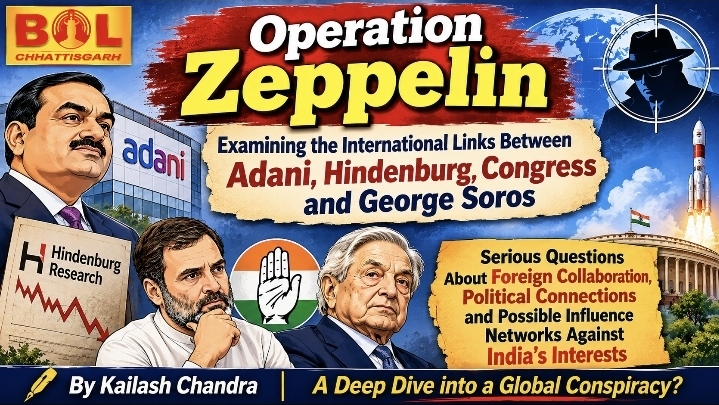
In a detailed analytical piece exploring the intersection of global finance and Indian politics, author Kailash Chandra has raised serious questions regarding alleged foreign collaborations and their potential influence on India’s democratic discourse. Through his latest writing, Chandra claims that recent international reports point toward a coordinated network targeting Indian interests, specifically highlighting the controversies surrounding the Adani Group, Hindenburg Research, the Congress party, and billionaire financier George Soros.
Table of Contents
One Report, Many Questions
In January 2023, the Hindenburg Research report on the Adani Group triggered widespread turmoil across India’s economy, stock market, and political landscape. As Adani Group shares witnessed a sharp decline, the issue dominated parliamentary proceedings, with the Congress and other opposition parties launching a sustained campaign targeting the relationship between the government and the conglomerate.
In a detailed analytical study examining these developments, author Kailash Chandra explores a deeper geopolitical question raised by Russia’s Sputnik India in April 2025: Was an international network operating behind the scenes?
Citing anonymous sources, the Sputnik report referred to an alleged intelligence operation called ‘Operation Zeppelin’, reportedly conducted by Israel’s intelligence agency, Mossad. Under the directions of Prime Minister Benjamin Netanyahu, Mossad allegedly investigated an international network working against the Adani Group. The report pointed to possible connections involving individuals associated with the Congress, Sam Pitroda, Rahul Gandhi, Hindenburg Research, and organisations linked to billionaire financier George Soros.
Sam Pitroda’s Servers and the Alleged Digital Evidence
The most serious claim in the Sputnik report concerns alleged intelligence access to servers at Sam Pitroda’s residence in the United States and the collection of digital communications from them. The report claimed that indications of contact and coordination between Rahul Gandhi and Hindenburg founder Nathan Anderson had been found, alongside links to Soros-backed organisations, foreign media outlets, lawyers, financial groups, and American institutions.
Addressing these explosive claims, the analysis argues that if such digital evidence actually exists, it must be subjected to independent forensic examination. Server logs, metadata, and authenticated communication records should either be made publicly available or submitted to the appropriate investigative authorities.
However, the alleged 353-page dossier has not been made public, nor is there official confirmation from Mossad or independently verified cyber-forensic evidence. Consequently, these claims require thorough investigation and verification rather than blind acceptance.
Hindenburg, Adani and Foreign Financial Influence
When Hindenburg published its allegations of financial irregularities on January 24, 2023, the Adani Group responded in detail, rejecting the claims as baseless and misleading. The matter subsequently reached SEBI and the Supreme Court of India. On January 3, 2024, the Supreme Court declined a request to transfer the investigation to a Special Investigation Team (SIT) or the CBI, and by September 2025, final SEBI orders brought the related proceedings to a close.
Beyond the legal battles, the author highlights a larger economic question. Because international short sellers adopt strategies designed to profit from falling share prices, it is entirely reasonable to examine their research, financial interests, sources of information, and possible conflicts of interest. Any international activity capable of affecting India’s economic interests must be scrutinized on the basis of evidence and law.
George Soros and the Question of Political Influence
The commentary also examines the role of George Soros, recalling his public statement at the Munich Security Conference on February 16, 2023, where he suggested the Adani controversy could weaken the political position of Prime Minister Narendra Modi.
While Soros’s Open Society Foundations provides financial support to projects related to democracy, human rights, and civil society globally, the study stresses that the transparency of its funding, partners, and activities in India deserves strict scrutiny. Media speculation has long swirled around whether Soros funded Hindenburg, collaborated with the Congress on an anti-Adani campaign, or supported a broader plan for regime change in India. Because much of this remains unverified amidst political accusations and counter-accusations, the piece calls for formal investigation over assumptions.
Foreign Collaboration and India’s Institutional Security
In the modern era, international influence is no longer limited to military or diplomatic activities; foreign funding, research institutions, media networks, digital platforms, NGOs, and financial groups can heavily shape public opinion and policy debates.
The study argues that India must address four fundamental questions based on financial records, digital evidence, and the law:
- What are the actual sources and patterns of expenditure of organisations receiving foreign funds?
- Is foreign funding being used to influence Indian political activities or electoral debates?
- Do the interests of international media organisations and financial groups shape particular political narratives?
- Are attempts being made to gain unauthorised access to the digital information of Indian political and public institutions?
Importantly, the analysis notes that in April 2025, Nathan Anderson rejected the allegations related to Operation Zeppelin, describing the story as ‘lousy spy fiction’. He denied meeting Rahul Gandhi, travelling to Palo Alto, or having the alleged contacts with the US administration—a denial that remains a key part of the overall assessment.
From International Networks to India’s Political Discourse
Transitioning from international networks to domestic politics, Kailash Chandra poses three pointed questions to India’s political discourse:
- Political Ideology and National Interest Critiquing the opposition’s political alignments, the author remarks that India would hardly need separate separatist, anarchist, Maoist, or Jihadi-Mujahideen ideologies to challenge the nation if the Congress party itself takes responsibility for representing such fronts.While the right to political opposition is a strength of democracy, the article argues that supporting violence, separatism, anarchy, or activities that undermine India’s constitutional order in the name of opposition is unacceptable. The statements and politics of Congress leaders must be judged by the standard of national unity, though the author adds that branding any political party as a representative of these ideologies requires concrete evidence.
- Foreign Connections and Regime Change Questioning those “whose own résumés have changed,” the piece asks whether individuals and organisations with scrutinized foreign collaborations and funding are now attempting to engineer a regime change in India. While international contacts are not crimes in themselves, any attempt to use them to influence India’s sovereignty, democratic institutions, or independent decision-making must be impartially investigated. India’s political future must be decided by Indian citizens, not by foreign financial networks.
- The 2014 Mandate and Today’s ‘Vote-Chori’ Narrative
In the 2014 general election, following ten years of the UPA government under Prime Minister Manmohan Singh, the Congress was reduced to 44 seats while the BJP won a clear majority with 282 seats. Pointing to this historic transformation, the article asks whether inflation, corruption allegations, a leadership crisis, dissatisfaction with governance, and the expectations surrounding Narendra Modi’s leadership were the true drivers of that decisive mandate. Addressing current political allegations of ‘vote chori’ (vote theft) regarding electoral processes and voter lists, the commentary insists that the 2014 mandate—like every election result—must be evaluated against hard evidence, Election Commission records, and democratic accountability.
In a Nutshell
Author Kailash Chandra emphasizes that the issue ultimately transcends any single industrialist, political party, or foreign organisation, it is a question of India’s economic sovereignty, democratic independence, and national interest. Foreign connections must be investigated, political accountability established, and electoral mandates respected, ensuring that India’s future is decided solely by the people of India.
Disclaimer: The views, claims, and political arguments presented in this article are based on an analytical study by author Kailash Chandra and reflects his personal perspective.